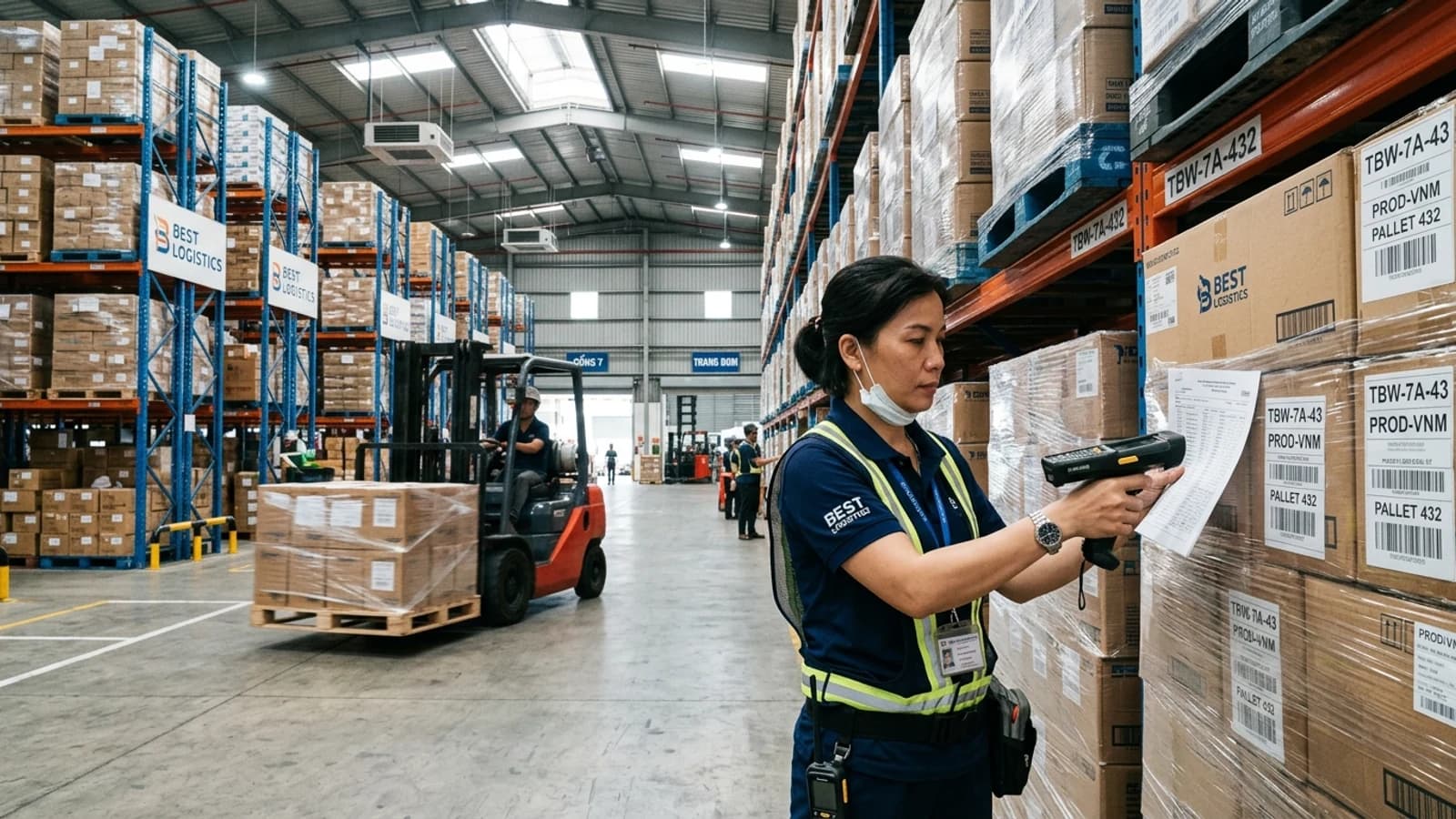
A business with two or more warehouses almost always shows the same symptom: the total in the software disagrees with what gets counted on the floor. The cause is rarely the software. It is one of the five below, and all five are fixable with correct configuration plus a few working conventions.
Error 1: Goods in transit have nowhere to be
Warehouse A ships 100 cases at 9am; warehouse B receives them at 3pm. Where are those 100 cases for six hours? If the system deducts at A and adds at B immediately, stock is wrong for six hours. If it only deducts from A once B confirms, A still shows goods that are already on a truck.
The fix: create a virtual "in transit" warehouse. Issuing from A moves goods there; they leave only when B confirms receipt. The total is always right, and the balance sitting in that virtual warehouse is your measure of goods floating around — usually a figure that startles management the first time they see it.
Error 2: One product, three codes
The Bien Hoa warehouse calls it "Box steel 30x30", Trang Bom writes "Square tube 30", the third uses an internal code "TH3030". Three codes, three stock lines, and no total is correct.
The fix: standardise the catalogue once and take the pain once. Pick one canonical code, merge the history, and most importantly — let only one person create new product codes. Give a dozen people that right and the catalogue is a mess again within six months.
Error 3: Units of measure that do not agree
Purchasing counts cases, sales counts boxes, the stocktake counts pieces. How many boxes in a case, how many pieces in a box — if that ratio lives in the storekeeper’s head rather than in the system, every conversion is a chance to be wrong.
The fix: each product has exactly one base unit, usually the smallest, with every other unit declared against a conversion factor. All arithmetic runs on the base unit; only the display uses whatever unit the user is used to.
Error 4: Recording late
Goods arrive Friday afternoon; the receipt is entered Monday morning. For two days sales sees an empty shelf and turns orders away, while the stock is sitting in the warehouse.
The fix: move recording to the point it happens — the receiver scans with a phone at the warehouse door rather than waiting for paperwork to reach the office. That is a change to how people work, not to the software, and it is usually the hardest change of the five.
Error 5: One stocktake a year
A full count at year end means a year of drift accumulating, and by the time it surfaces the cause is untraceable.
The fix: cycle counting. Count a small group of products each week, prioritising high value and fast movers. Every item gets counted several times a year and nobody ever shuts the warehouse for a day. Discrepancies found early can still be traced to a cause.
Four numbers to watch weekly
- Value of goods in transit — unusually high means a shipment is stuck, or somewhere forgot to confirm receipt.
- Products showing negative stock — must always be zero. Anything else means transactions are being recorded out of order.
- Cycle-count variance — a rising trend means the process is loosening.
- Stock with no movement in 90 days — dead money on the shelves, and usually a larger sum than anyone expects.
None of these four needs a sophisticated system. They need data recorded at the right moment and a clean catalogue — precisely the two things the four errors above destroy.
Want to talk specifics?
SealCore surveys at your premises and sends a fixed quote after the first session — including when the conclusion is that you do not need custom software.