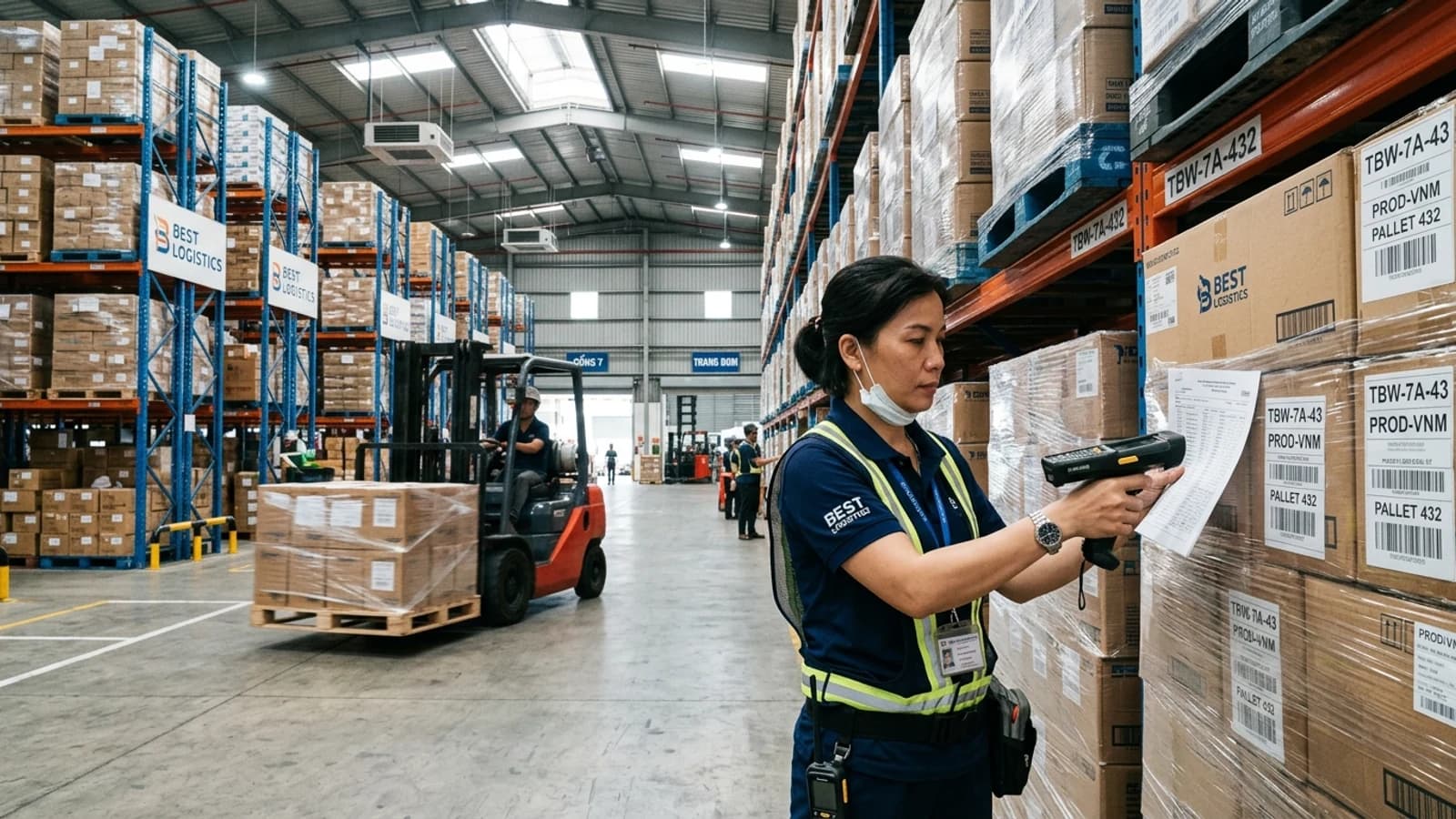
Manufacturers in Dong Nai share one trait: their operating sites are far apart. A plant inside the Amata or Loteco industrial park, a rented warehouse in Trang Bom or Long Thanh, an office in Bien Hoa. Three places, three ways of recording, and at month end somebody has to stitch it together.
For this shape of business, the order of digitisation matters more than the tool. Get the order wrong and you spend the money while the numbers still disagree.
First: one place that knows the stock
Before touching work orders or reporting, there has to be a single place that answers "how much is left, and in which warehouse". As long as each warehouse keeps its own ledger, every number downstream is an estimate.
In practice the hard part is not the software but three jobs: standardising the material catalogue (the same steel written three ways in three warehouses), agreeing units of measure, and one clean stocktake to establish opening balances. Skip those and the new system is just a faster place to store wrong numbers.
Second: work orders tied to sales orders
Once stock is trustworthy, the next step is connecting production to real demand. A work order should know which sales order it serves, what materials it needs by the norm, and how much has been issued.
- Material norms per product — including the allowed wastage, because that is the figure the floor and accounting argue about most.
- Issue materials against a work order, not in bulk: only then can you cost each batch properly.
- Record output per shift, so you can compare productivity between shifts and between lines.
Third: batch traceability
A customer complains about a faulty batch. The immediate questions: which day and shift produced it, which supplier’s raw material went in, and who else received goods from the same run?
If answering takes half a day of digging through ledgers, the loss is not just time — it is recalling far more widely than necessary because you cannot narrow the scope. Batch traceability is small technically but saves money quickly, especially for exporters or firms doing contract work for a parent company.
Fourth: consolidated reporting for management
By now the data supports reports that mean something. Four numbers a production director usually wants daily:
| Indicator | Answers | Comes from |
|---|---|---|
| Output per shift against plan | Are we on schedule today? | Output recording |
| Wastage against the norm | Are we losing material abnormally? | Material issues per order |
| Raw material nearing reorder point | Will a line stop next week? | Consolidated stock |
| Late delivery orders | Which customer is about to complain? | Sales orders + work orders |
Why to choose a partner nearby
The three parts of a plant project that break most often all have to be done on site: surveying the process (you have to stand on the floor to see it), the stocktake for opening balances (someone has to be in the warehouse), and training (operators do not learn it from a video call). That is a practical reason — not a marketing one — to choose a firm that can be at the plant the same day.
SealCore is based in Bien Hoa and works across the province; the districts we cover and our travel commitments are on the software solutions in Dong Nai page.
Want to talk specifics?
SealCore surveys at your premises and sends a fixed quote after the first session — including when the conclusion is that you do not need custom software.